
Fully Underground vs. Semi-Underground Waste Containers: Which System Is Right for Your Project?
Choosing between fully underground and semi-underground waste containers involves more than comparing their appearance or storage capacity. While both systems store waste underground, they vary in terms of their installation process, collection method, space consumption, and maintenance.
In projects where appearance and space efficiency are priorities, a fully underground waste container system may be more suitable. A semi-underground storage system may be more flexible in some cases.
Choice depends on installation space availability, ground conditions, existing collection facilities, and other operational requirements.
How Fully Underground and Semi-Underground Waste Containers Differ
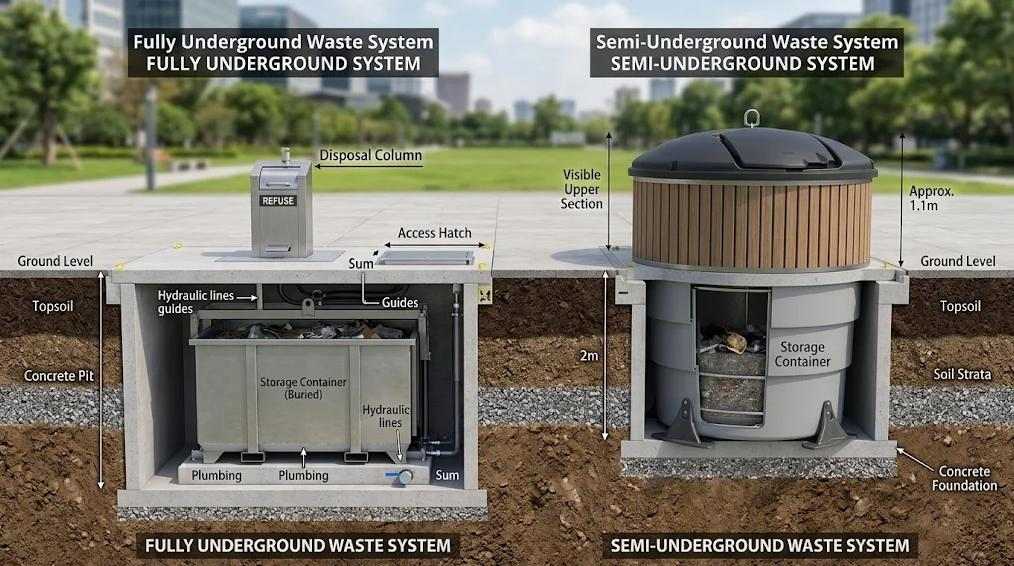
The key distinction lies in the extent of the container that is installed below the surface and the way waste is collected.
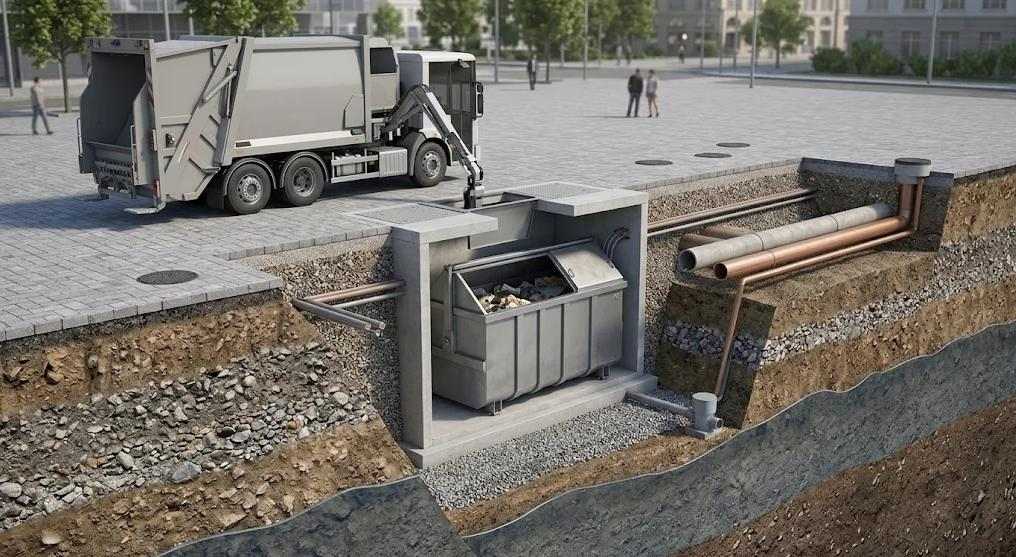
In the case of fully underground waste containers, the storage units and lifting units are installed below the ground surface. Only access openings and the top platform are visible. Depending on the design, waste containers can be raised using a hydraulic lifting platform or a crane-lifting system. In hydraulic lifting systems, standard wheeled bins can be raised to ground level for collection.
For semi-underground waste containers, about one-third to two-thirds of the container is above the ground. Many designs use an internal lifting bag or container that is raised by a crane-equipped collection vehicle. The upper part of the container serves as the opening point for waste dumping, while the underground part serves as extra storage.
These systems serve similar waste collection purposes, but their different structures affect how they fit into a project.
Key Differences That Affect Project Selection
When evaluating underground waste containers, project managers should consider more than the storage capacity each system offers. The following four factors can directly affect installation and daily operation.The following four elements influence the performance of the system.
| Comparison Factor | Fully Underground | Semi-Underground |
| Ground-level appearance | Smaller visible footprint, with access openings and a top platform | Larger container section remains visible |
| Installation | Requires deeper excavation and underground structural preparation | Generally requires less burial depth, depending on the model |
| Waste collection | Hydraulic lifting or crane lifting, depending on the system | Commonly uses crane-lifted inner containers or bags |
| Maintenance | May involve hydraulic, electrical, platform, and drainage components | Focuses on container structure, lifting bags, and lifting components |
Space Needs and Visibility
Fully underground systems are particularly suitable for projects where keeping the ground-level environment open and unobstructed is important. Such systems can be used in residential projects, pedestrian walkways, business districts, and public areas with high landscape standards.
Semi-underground containers have larger visible structures, but above-ground portions of such systems allow greater flexibility in designing the container form, access, and finish.
Installation Conditions and Groundwork
Completely underground systems need adequate depth of excavation and proper design of the underground structure. It is necessary to check existing utility lines, groundwater levels, soil stability, and drainage conditions prior to installation.
Semi-underground systems may require shallower excavation and therefore can be considered in cases when deeper excavation is not easy. However, suitable foundation and drainage design are required for such systems.
Waste Collection and Vehicle Compatibility
The type of collection determines whether underground waste storage will work for a given location.
In hydraulic lifting systems, standard wheeled bins are raised from underground to ground level, where they can be emptied using compatible bin-lifting equipment. Crane-lifted systems need proper lifting vehicles and enough space for operations.
With semi-underground systems, lifting vehicles fitted with cranes are used to lift the internal bags/containers. Before choosing one of the two systems, make sure that there are compatible vehicles with the waste collection contractor.
Maintenance and Long-Term Operating Costs
The two technologies need constant checking and cleaning; however, their maintenance requirements are different.
Hydraulic fully underground systems will involve the checking of cylinders, electrical systems, lifting platforms, and drainage systems. Maintenance of semi-underground systems typically involves inspecting lifting bags, lifting mechanisms, container structures, and ground-level components.
It is necessary to take into account the costs associated with the equipment, civil engineering, installations, collection services, and maintenance of the systems in the total project cost. There is nothing certain about one system being less expensive than another.
Which Waste Container System Fits Different Project Types?
Waste volume, available space, and collection requirements vary from one project to another. These factors should be considered when evaluating the two systems.
| Project Type | Key Selection Considerations |
| Residential communities | Resident convenience, available space, waste volume, and collection frequency |
| Commercial complexes | Peak waste generation, pedestrian traffic, and collection access |
| Public squares and pedestrian streets | Ground-level appearance, available space, and construction restrictions |
| Parks and tourist attractions | Landscape integration, visitor access, and maintenance convenience |
| Municipal waste collection points | Storage capacity, waste sorting, and compatibility with municipal collection vehicles |
For instance, a residential development with less visible space on the ground may be suited to an underground system. A park that has enough installation space and a reliable crane-based collection facility may be suited to a semi-underground system.
The type of project alone should not be used when making this decision. It will be necessary to conduct a site evaluation to see whether the chosen system will work there.
What Should You Check Before Choosing an Underground Waste Container?
Before making a purchase decision regarding underground waste containers, the project owners and contractors need to consider five critical issues:
- Space for installation and excavation depth: Determine the size of the installation area and excavation depth.
- Volume of waste produced and container capacity: Calculate the volume of the waste that is produced and how many containers are required.
- Collection trucks and lifting devices: Ensure that the existing collection trucks can work with the lifting devices without the need to invest in extra equipment.
- Ground conditions and drainage: Investigate all of these prior to starting the construction process.
- Inspection and maintenance costs: Consider all of the costs involved in the maintenance of the system.
Taking these issues into consideration in advance will help avoid any problems during installation and select the equipment that suits the project’s needs.
Final
In projects where a clean ground-level appearance and economical use of public space are priorities, underground waste containers are a strong option. HD Outdoor Facilities manufactures fully underground waste container systems with hydraulic lifting platforms designed for standard 660L and 1100L wheeled bins. with a variety of container combinations to suit your waste collection needs.
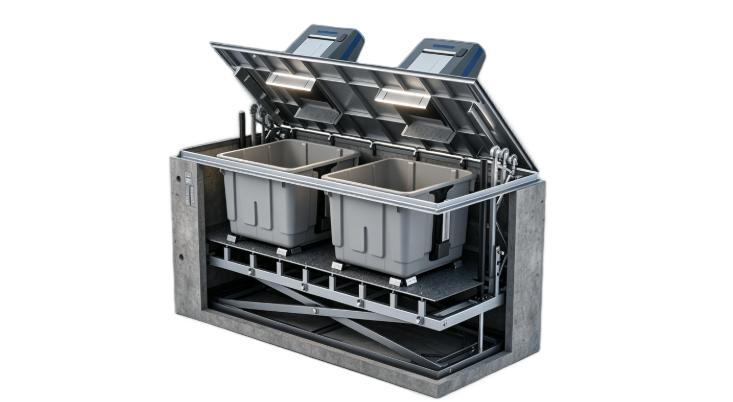
As an OEM/ODM manufacturer, HD offers customization options for container materials, dimensions, colors, access controls, and functional modules. Regardless of whether you are undertaking a residential, commercial, or municipal waste collection project, we can assist you in evaluating your needs and designing an appropriate underground waste container system.
Explore our underground waste container range or contact HD Outdoor Facilities to discuss your project requirements.