
How to Create Inclusive Public Spaces with Accessible Outdoor Furniture?
Accessible design plays an important role in making public spaces comfortable and safe for people with different needs. When it comes to outdoor furniture, accessibility involves more than simply adding armrests to a bench or adjusting the height of a waste bin. The design of the furniture, the space around it, and its location along pedestrian routes can all affect how easily people can use it.
Wheelchair users, older adults, people who use walking aids, people with visual impairments, and parents with strollers may all face different challenges when using outdoor furniture. For municipalities, landscape architects, property managers, and buyers, considering accessibility during the planning stage can make projects easier to use and may also help avoid expensive modifications later.
This article looks at the key considerations for accessible outdoor furniture, including common design problems, relevant international standards, and practical factors to keep in mind when choosing and installing benches, tables, waste receptacles, and other types of street furniture.
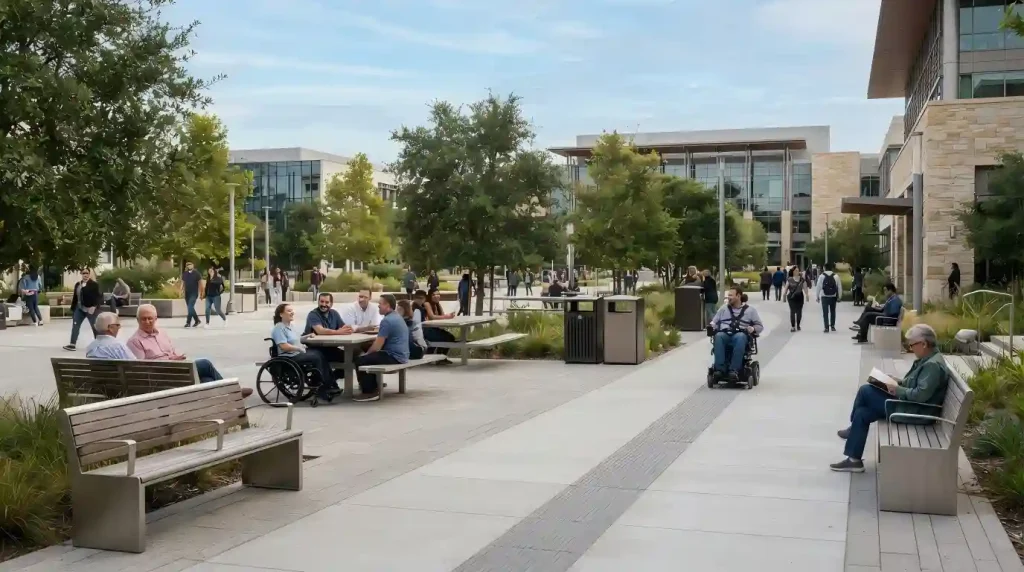
What Is Accessible Design for Outdoor Furniture?
Accessible design makes public facilities easier to use for people with different physical abilities and helps remove unnecessary barriers.
Accessible design is closely related to universal design, but the two are not quite the same. Accessibility generally focuses on making spaces and products usable for people with disabilities. Universal design takes a wider approach by considering the needs of different users from the start.
For example, an outdoor bench with a stable seat, a comfortable height, armrests, and enough clear space beside it can be more convenient for older adults, people recovering from an injury, and wheelchair users who are spending time with family or friends.
The same applies to waste receptacles. A bin may have an accessible opening height, but that does not necessarily make it easy to use. If it is placed in the middle of a pedestrian route or next to a raised curb, some users may still have difficulty reaching it.
This is why accessible outdoor furniture should be considered together with the space around it. The furniture needs to be easy to use, but its placement and the surrounding pedestrian area also need to work for different users.
Key Accessibility Principles for Outdoor Furniture
Keep Accessible Routes Clear
Outdoor furniture should not unnecessarily narrow an accessible pedestrian route. Benches, waste bins, planters, signs, and other street furniture should be positioned so people can move around them safely and comfortably.
Under the 2010 ADA Standards, an accessible route generally requires at least 36 inches (915 mm) of clear width, although specific requirements can vary by application. When planning a project, it is important to account for the furniture from the start rather than checking the remaining pathway space after installation.
Provide Enough Approach and Clear Space
People using wheelchairs or mobility aids need enough space to approach and use outdoor furniture. The amount of space required depends on the type of furniture and the direction of approach.
The 2010 ADA Standards commonly use a 30 × 48 inch (760 × 1220 mm) clear floor or ground space for accessible elements. When placing benches, tables, or waste receptacles, also consider nearby walls, curbs, planters, and other obstacles that may limit access.
Consider Height, Reach and Ease of Operation
Important parts of outdoor furniture should be within a practical reach range and easy to operate. This is especially relevant for waste receptacles, recycling bins, information boards, and other products with handles, lids, openings, or controls.
The ADA Standards also address reach ranges and accessible operating mechanisms, including requirements that help avoid the need for tight grasping, pinching, or twisting of the wrist.
Choose Safe and Durable Materials
Accessibility is not only about dimensions. Furniture and the surfaces around it should remain stable and safe during everyday use.
Stable construction, secure anchoring, smooth edges, and materials suitable for the local climate can all help reduce potential hazards. Damaged surfaces, loose components, corrosion, or uneven installation can also create problems over time, even when the original furniture met accessibility requirements.
Use Clear Visual Identification
Outdoor furniture should be easy to identify and distinguish from its surroundings. Appropriate color contrast can make benches, bins, signs, and other street furniture easier to see, while clear labels can help users understand different functions.
The position of street furniture also matters for people with reduced vision. It should not create unexpected obstacles along pedestrian routes and should be placed where it can be detected and navigated around safely.
Accessible Design for Different Types of Outdoor Furniture
Accessible Outdoor Benches and Public Seating
Benches are common in parks, streets, plazas, and other public spaces, but their accessibility depends on more than seat height.
Seat height, seat depth, back support, armrests, and the space around the bench all affect how easily people can use it. A seat height of around 430–500 mm is often suitable for many users, although the appropriate dimension will depend on the project and intended users.
Armrests can make it easier for older adults and people with limited mobility to sit down and stand up. Clear space beside the bench is also important. A wheelchair user may sit alongside the bench rather than on it, allowing them to stay with family or friends.
The surrounding layout should be checked at the same time. A well-designed bench can still be difficult to access if it is placed against a wall, curb, planter, or narrow pedestrian path.

Accessible Picnic Tables and Outdoor Tables
Accessible picnic tables should provide enough knee and foot clearance for a wheelchair user to sit comfortably at the table.
The table base is an important detail. Closely spaced legs or a central support can prevent a wheelchair from moving underneath the tabletop, even when the table height is suitable.
For fixed tables, the accessible seating position should connect to an accessible route and have enough clear ground space. When selecting a picnic table, check the space beneath the tabletop as well as the overall table dimensions.
Accessible Outdoor Trash and Recycling Bins
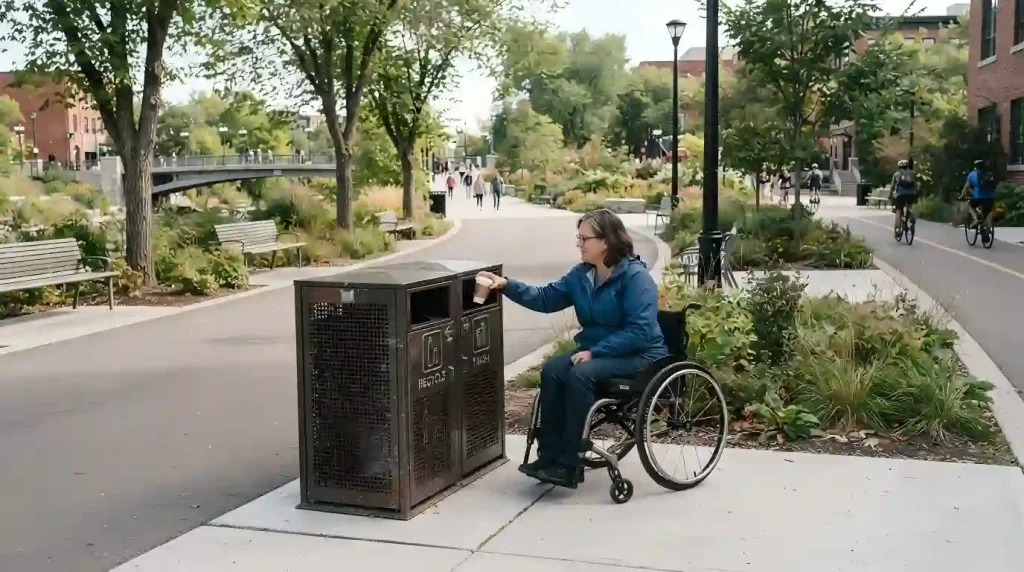
Waste receptacles are easy to overlook when planning accessible public spaces. The opening should be within a practical reach range, and users should be able to operate the lid or other components without excessive force or awkward movements.
There should also be enough space around the bin for a wheelchair user to approach it without blocking the pedestrian route. For recycling stations with multiple compartments, clear labels and visual differences can make the different waste streams easier to identify.
When evaluating a bin, look at the opening, operating method, approach space, and installation position as a whole, rather than considering the product dimensions alone.
Ashtrays and Other Street Furniture
Ashtrays, donation boxes, bike racks, bollards, information boards, and similar street furniture can also affect accessibility.
In many cases, the main concern is their location rather than the product itself. Poorly positioned furniture can narrow a pedestrian route, create an unexpected obstacle, or make navigation more difficult for people with visual impairments or mobility aids.
Street furniture should be positioned consistently and kept clear of the main pedestrian path. UK guidance on inclusive mobility also recognizes poorly placed street furniture as a potential barrier for wheelchair users and people with visual impairments.
Common Accessibility Mistakes in Outdoor Furniture Projects
Accessibility problems in outdoor furniture projects are not always caused by the furniture itself. In many cases, they come from how the furniture is planned, positioned, and used within the wider site.
1. Treating Accessibility as an Afterthought
A common mistake is to plan the pedestrian route first and add benches, bins, tables, and other furniture later. This can leave too little space for people to move around or approach the furniture.
Accessibility should be considered as part of the site layout from the beginning, before the final furniture positions are decided.
2. Providing a Bench Without Enough Adjacent Space
A bench with a suitable height and armrests is not necessarily accessible. Wheelchair users may need clear space beside the bench, while other users may need enough room to approach and move around it.
The space around the bench should be considered alongside the bench itself.
3. Placing Waste Bins Too Close to the Path
Waste bins do not usually take up much space, but a poorly positioned bin can narrow an accessible route or make movement more difficult.
Instead of looking only at the product footprint, check the actual clear width of the route after the bin has been installed.
4. Focusing Only on Product Dimensions
Meeting a particular dimensional requirement does not always mean that a piece of furniture will be easy to use. Pavement conditions, slopes, curbs, landscaping, nearby furniture, and the direction of approach can all affect accessibility.
For this reason, furniture should be evaluated as part of the overall site rather than as a standalone product.
5. Relying on Accessibility Signs
An accessibility symbol does not make a space accessible on its own. The route, clear space, furniture position, reach range, and ease of use still need to meet the needs of the people using the space.
Signs can help identify accessible facilities, but they should support good design rather than replace it.
Accessibility Standards: ADA and Global References
Accessibility requirements are not the same everywhere. They can vary by country and may also differ between states, provinces, municipalities, building types, and individual projects.
In the United States, the 2010 ADA Standards for Accessible Design are an important reference for accessible buildings and facilities. The standards cover areas such as accessible routes, clear floor and ground space, reach ranges, operating mechanisms, seating, and tables.
For projects outside the U.S., the applicable local requirements should be checked first. In the UK, for example, the Department for Transport’s Inclusive Mobility provides guidance for accessible pedestrian environments and includes recommendations related to the placement of street furniture.
For international projects, ADA standards can provide useful design guidance, but they do not replace local accessibility requirements. Before finalizing the design or installing outdoor furniture, project teams should check the regulations and guidance that apply to the specific location.
How to Apply Accessible Design from Planning to Installation
Accessibility should be considered throughout the project, from the initial site layout to ongoing maintenance.
During planning, identify accessible pedestrian routes before deciding where benches, tables, bins, and other furniture will go. Make sure the furniture does not reduce the usable width of these routes or block access to other facilities.
During product selection, look beyond appearance and price. Check the product dimensions, clearances, operating features, materials, durability, anchoring method, and the accessibility requirements that apply to the project.
During installation, check the actual space around each piece of furniture. Site conditions such as landscaping, curbs, slopes, and nearby furniture can reduce usable space even when the original drawings show adequate clearance.
During maintenance, keep an eye on changes to the site. Furniture can shift, become damaged, or end up surrounded by temporary objects such as equipment, signs, or stored materials. Regular checks can help prevent these changes from turning an accessible route into an obstacle.
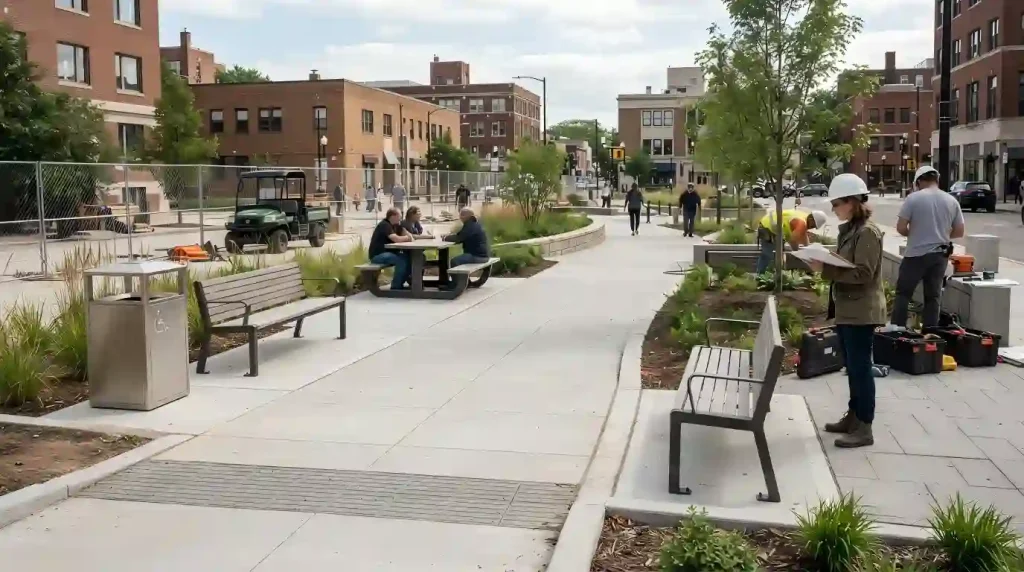
How Outdoor Furniture Manufacturers Can Support Accessible Projects
Outdoor furniture manufacturers can help address accessibility requirements before products reach the installation stage. At HD outdoor facilities, we can work with designers, buyers, and project teams to review product specifications and find suitable solutions for different outdoor environments.
When standard products do not fully meet a project’s requirements, customization may be an option. Depending on the product, details such as seat height, table configuration, waste opening position, mounting method, and other dimensions can be adjusted to better suit the site and intended users.
Material and finish selection also affects how outdoor furniture performs over time. Factors such as corrosion resistance, structural strength, surface durability, and ease of maintenance are especially important for furniture used in public spaces and other high-traffic areas.
For municipal, commercial, and landscape projects, HD can provide support during the planning and product selection stages, helping customers review dimensions, installation conditions, material options, and customization requirements before production. This can make it easier to choose furniture that works with the site’s accessibility needs from the beginning.
Frequently Asked Questions
Is all public outdoor furniture required to be accessible?
Not necessarily. Requirements depend on the type of facility, project, jurisdiction, and applicable accessibility regulations. However, furniture should be planned as part of the overall accessible public environment.
What makes an outdoor bench accessible?
An accessible bench should provide suitable seating dimensions, stable construction, and features such as armrests where appropriate. The surrounding area also needs enough clear space for approach and circulation.
How much space should be provided beside an accessible bench?
The required space depends on the applicable standard and site configuration. In many projects, a clear wheelchair space of approximately 30 × 48 inches (760 × 1220 mm) is a useful reference, but the final layout should be checked against the requirements that apply locally.
What should be considered when choosing accessible outdoor trash bins?
Look at the opening height, reach range, operating method, approach space, visibility, and installation position. A bin should be usable without blocking the accessible pedestrian route.
Does ADA apply to outdoor furniture outside the United States?
ADA is a US accessibility standard and should not automatically be applied as the legal requirement in another country. International projects should follow the accessibility regulations and standards applicable to their location.