
How to Choose Weather-Resistant Outdoor Trash Bins?
Outdoor trash cans are constantly exposed to factors such as rain, sunlight, moisture, strong winds, and daily impacts. Trash cans suitable for indoor use may not be suitable for outdoor scenarios. Whether used in parks, streets, commercial areas, residential communities, or public projects, when choosing outdoor trash cans, one should not only focus on appearance and capacity.
The material, waterproofness, resistance to ultraviolet rays, corrosion resistance, local climate, and overall structure all affect the lifespan and performance of the trash cans. When making a purchase, one needs to pay close attention to the following aspects.
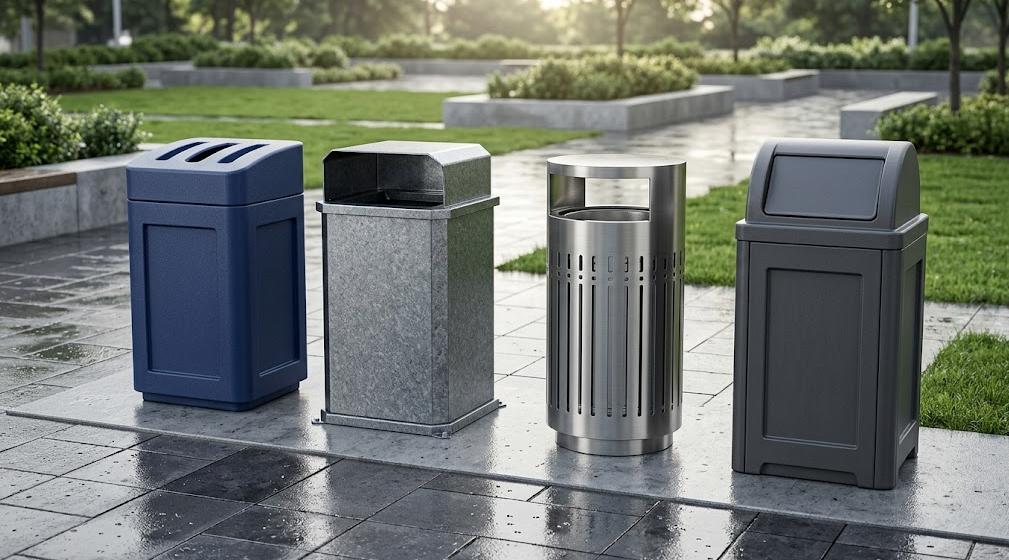
Choose the Right Material for Weather-Resistant Outdoor Trash Bins
The material is a crucial factor when choosing an outdoor trash can, directly influencing the durability of the product, maintenance requirements, and environmental adaptability.
HDPE (High-Density Polyethylene) trash cans are suitable for common outdoor places such as parks, communities, and schools. HDPE is lightweight, moisture-proof, and rust-resistant, and offers various colors and capacities, making it suitable for garbage collection and recycling.
Galvanized steel trash cans have higher structural strength and are suitable for public areas with high foot traffic. The galvanized layer can reduce the corrosion risk of steel, and the powder coating can further enhance the protective performance and appearance quality.
For coastal or high-humidity environments, stainless steel trash cans are usually more suitable, with excellent corrosion resistance and maintaining a clean appearance.
The material selection should be based on environmental conditions, usage frequency, maintenance requirements, and budget, rather than simply pursuing the highest material strength.
Look for Waterproof and Drainage Features in Outdoor Trash Bins
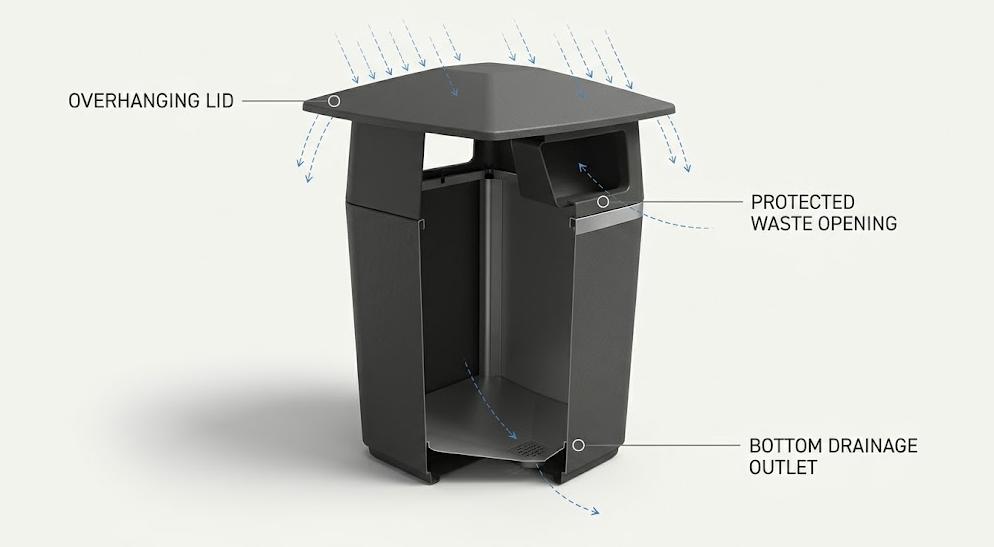
Outdoor trash cans do not necessarily need to be completely sealed, but they should minimize the entry of rainwater and prevent water accumulation inside.
The first thing to consider is the design of the lid and the discharge opening. A reasonable lid can prevent rainwater from entering directly, and a lid with a protective design can further reduce the possibility of rainwater entering the garbage storage area.
The bottom of the can also needs attention. If rainwater enters the can, there should be an effective drainage design to avoid water accumulation remaining in the inner tank or around the internal structure.
When purchasing, you can focus on checking the following designs:
- Top cover or eaves-like cover plate
- Garbage discharge opening with protective design
- Tilted surface conducive to drainage
- Reasonably set drainage holes
- Removable inner tank for easy cleaning
You can also ask the supplier a simple question: Where does the rainwater go after heavy rain?
This question can usually directly reflect whether the product truly takes into account the outdoor usage environment.
Check UV and Corrosion Resistance of Outdoor Trash Bins
Rainwater is just one of the outdoor environmental factors. Long-term exposure to sunlight and humidity can also affect the lifespan of trash bins.
For plastic outdoor trash bins, the ability to resist ultraviolet rays is particularly important. If the material is not suitable for outdoor use, prolonged exposure to sunlight can cause discoloration, brittleness, or surface cracking. Therefore, it is necessary to confirm whether the plastic used has been formulated with a design specifically for outdoor resistance to UV rays.
For metal outdoor trash bins, corrosion resistance is also important. When choosing a steel trash bin, in addition to the thickness of the steel plate, attention should also be paid to the surface treatment process.
Common protective methods include:
- Galvanization
- Powder coating
- Made of stainless steel material
- Corrosion-resistant surface treatment
For instance, galvanized steel combined with an appropriate powder coating process can achieve both structural strength and outdoor corrosion resistance.
Match Outdoor Trash Bins to Your Climate and Environment
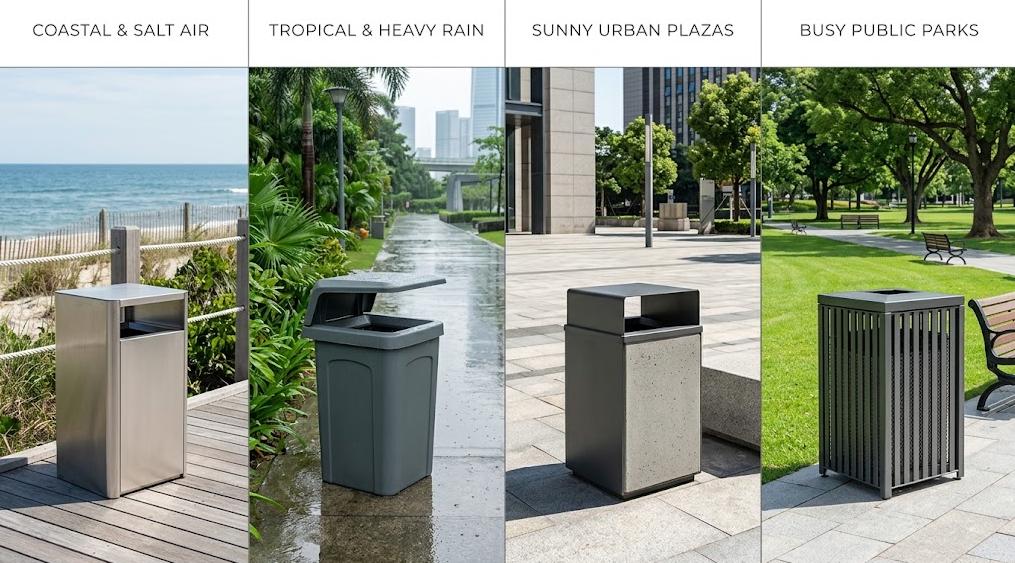
No outdoor trash can is perfect for all situations. When choosing the material and structure, local climate conditions should be fully considered.
For example, a trash can placed in a dry inland park is quite different from one in a coastal area. Salt, moisture, and frequent rainfall will accelerate corrosion, while strong sunlight places higher demands on the durability of plastic materials and surface coatings.
| Environment | What to Prioritize |
| Coastal areas | Corrosion resistance |
| Tropical or humid areas | Moisture resistance and drainage |
| Hot and sunny areas | UV resistance |
| Cold climates | Impact resistance |
| High-traffic areas | Strong structure and vandal resistance |
For large projects, do not make a purchase solely based on the photos in the product catalog. Instead, consider the actual installation environment comprehensively.
Choose Durable Commercial Outdoor Trash Bins for Long-Term Use
The material and surface treatment are important, but the overall structure also affects the performance of the trash can in long-term daily use.
Before ordering an outdoor trash can, you should check details such as wall thickness, bucket cover strength, hinges, corner reinforcement, inner liner, fixing device, wheels, and replaceable parts. For areas with high foot traffic, you should also consider strengthening the structure or designing for protection against damage.
For commercial and municipal projects, the customization capability is also an important consideration. Depending on the usage scenario, buyers may need different capacities, colors, logos, inner liners, installation methods, or garbage classification configurations.
Before placing an order, you can refer to the following checklist:
- What material is used?
- Does it have UV resistance?
- What kind of anti-corrosion treatment is used?
- How does rainwater drain?
- Is it suitable for humid or coastal environments?
- Can the structure withstand high-intensity daily use?
- Can the size, color, logo, or other configurations be customized?
- Does it provide spare parts?
High-quality weather-resistant outdoor trash cans are not necessarily the cheapest or the heaviest. The key is to match them with the local climate, installation environment, usage intensity, and maintenance requirements. For distributors, contractors, municipal departments, and commercial project owners, collaborating with experienced manufacturers can better meet customization needs and improve the quality and stability of large-scale orders.