
How Much Can a Waste Compactor Actually Save You in Transport Costs?
Installing the right waste compactor typically cuts hauling costs by 40% to 75%, with most facilities recovering their equipment cost in 12 to 24 months. Where you land in that range comes down to a few things: how often you’re currently paying for pickups, how your hauler structures its billing, and what type of waste you’re dealing with day to day.
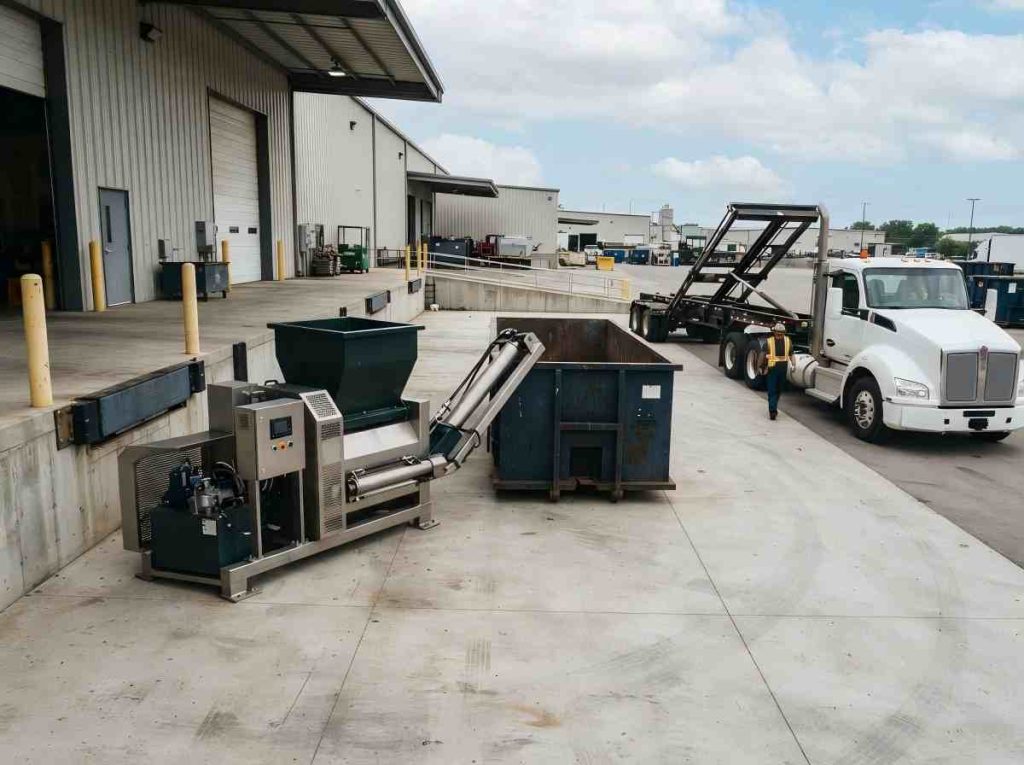
Why Open Dumpsters Cost More in Waste Hauling Fees
Most waste haulers charge one of two ways: a flat fee per pickup, or a lift fee combined with a per-tonne gate fee based on weight. Either way, you’re paying for how often a truck shows up — not strictly for how much waste you actually produce.
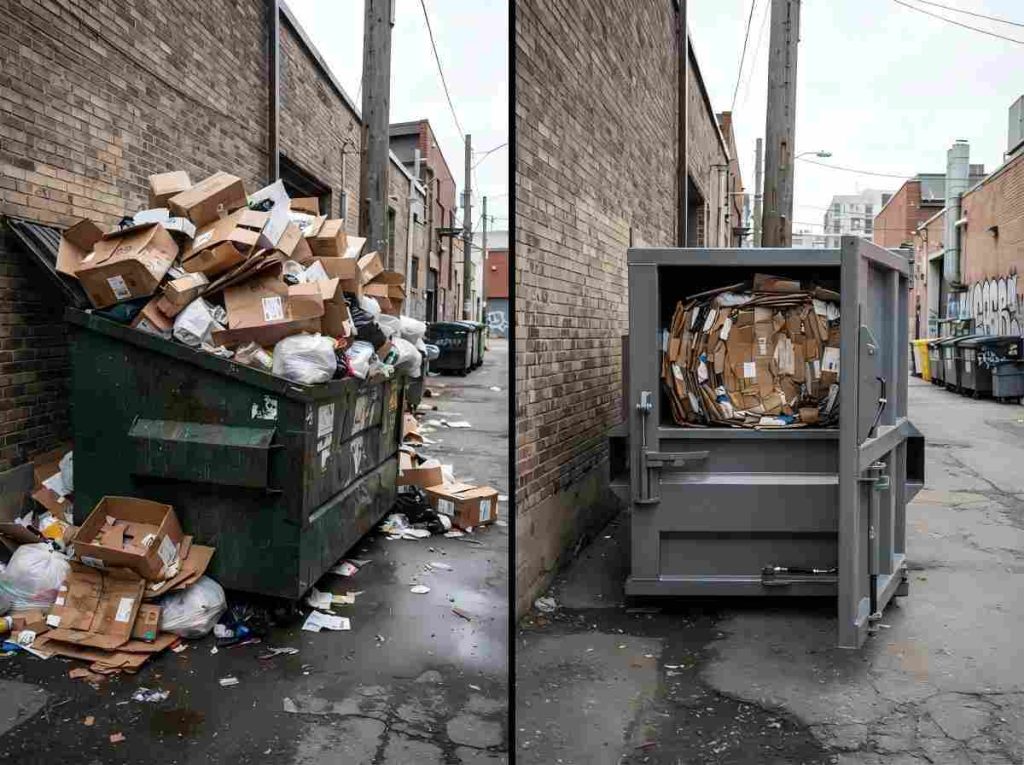
Open dumpsters make this worse than it needs to be. Loose waste is mostly air. Cardboard boxes collapse unevenly, packaging leaves gaps, and general trash settles into a shape that never fills the container efficiently. A dumpster that looks full at pickup time might only be holding a fraction of its real capacity, which means crews are hauling trips that are largely just empty space.
An industrial garbage compactor addresses this directly by compressing waste on site before it’s collected. The amount of trash generated doesn’t change, but the number of trips needed to move it drops significantly.
Waste Compactor vs. Dumpster: Pickup Frequency and Cost Compared
The easiest way to see where the savings come from is to compare collection frequency side by side, rather than looking at price alone.
| Variable | Open Dumpster | Compactor |
| Typical pickup frequency | 3–6 times per week | 1–2 times per week |
| Compaction ratio | None (loose waste) | Typically 4:1 to 8:1, depending on waste type |
| Cost driver | Frequency of pickups | Frequency of pickups + equipment cost |
| Space required | Similar footprint to a compactor | Similar footprint, but holds several times more waste |
The compaction ratio is the number that matters most here, and it varies more than people expect. Dense, mixed general waste might only compact around 4:1, while lighter materials like cardboard or packaging film can push closer to 8:1 or higher. If you don’t know your ratio, most compactor suppliers can estimate it based on a sample of your waste stream.
How to Calculate Your Waste Compactor Cost Savings
A workable estimate only needs three numbers, and you can run through it without any special tools.
Step 1: Find your current monthly hauling cost. Take your weekly pickup frequency, multiply by your per-pickup fee, then multiply by roughly 4.3 weeks.
Step 2: Apply your expected compaction ratio to estimate the new pickup frequency. A facility on six pickups a week with waste that compacts at roughly 5:1 will likely drop to one or two pickups a week after installing a compactor — the exact number depends on how consistently that waste volume compacts week to week.
Step 3: Recalculate your monthly cost at the new frequency, then subtract it from your baseline.
Here’s how that plays out with real numbers. A facility paying for six pickups a week at $75 each is spending around $1,935 a month. Drop that to one pickup a week, even at a slightly higher per-pickup rate (compactor containers sometimes carry a modest premium), and monthly costs fall to roughly $325–$400. That’s savings of well over $1,500 a month, or somewhere near $18,000 to $19,000 a year. Running the same math against your own numbers will give you a figure specific to your site rather than an industry average.
This is a planning estimate rather than a quote — actual savings will shift depending on your hauling contract terms, regional disposal rates, and how consistently your waste stream compacts.
Hidden Cost Savings Beyond Waste Transport Costs
Transport costs tend to get all the attention in these calculations, mostly because they’re the easiest number to pin down. They’re not the only savings on the table, though.
Reclaimed space. A compactor typically occupies about the same footprint as a standard dumpster, but holds three to five times the volume. On sites with limited loading dock or yard space, that difference can open up room for parking, storage, or better vehicle access — no construction required.
Labor time. Staff spend less time dealing with overflow, breaking down boxes to squeeze in more waste, or calling for emergency pickups when a dumpster fills early. On high-volume sites, that alone can save several hours a month.
Fewer compliance and nuisance issues. Overflowing bins attract pests, generate odor complaints, and in some cases raise health code concerns, which matters most for sites like central kitchens or hospitality operations handling high volumes of organic waste. The EPA’s guidance on commercial waste reduction notes that better containment and volume reduction are consistently linked to lower operational risk alongside cost savings.
For sites also tracking how full bins get before pickup, pairing a compactor with fill-level sensors can sharpen these numbers even further by replacing fixed collection schedules with data on actual usage — an approach we cover in more detail in our piece on IoT-enabled waste compactors.
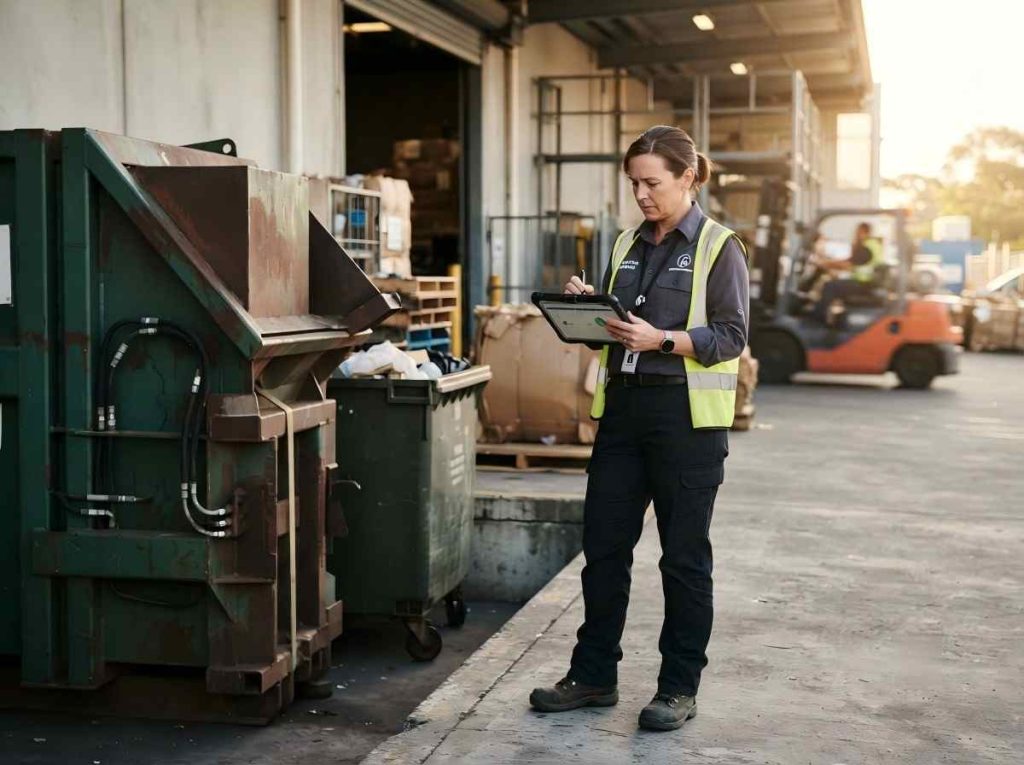
When a Waste Compactor Isn’t Worth the Investment
Not every site sees enough benefit to justify the investment.
Facilities generating a small volume of waste, or already locked into a favorable hauling contract, can end up with a payback period well past three years — long enough that the equipment cost outweighs realistic savings over its useful life. Compactors carry their own ongoing costs too: power consumption, routine maintenance, and occasional repairs, all of which chip away at the monthly savings on paper.
Sites generating more than a tonne of general waste per week tend to see the strongest returns. Below that threshold, it’s worth running the numbers carefully, or talking to a supplier who can model your specific waste stream, before committing to the purchase.
Get an Accurate Waste Compactor ROI Estimate for Your Site
The estimate above gets you close, but your actual number comes down to details that a generic formula can’t capture — local hauling rates, how your specific waste stream compacts, and the way your current contract is structured.
If you’re deciding between a fixed industrial garbage compactor and something more flexible like a mobile waste compactor, or you’re mainly dealing with food and kitchen waste and need dedicated treatment equipment instead, send us your current pickup frequency and container size. That’s enough for us to put together a projection based on your actual site rather than an industry average.