
How to Reduce Waste Collection Costs with an Efficient Waste Management System?
The cost of waste collection will increase rapidly due to frequent collection, labor, fuel, equipment maintenance, and inefficient transportation. For units with large amounts of waste production, such as municipal departments, commercial facilities, and residential communities, relying solely on low-cost equipment is often insufficient to truly reduce costs.
A more effective approach is to enhance the efficiency of the entire waste collection process. By reducing unnecessary collection frequencies, increasing waste density, using data to optimize collection plans, and coordinating equipment across all stages, it is possible to improve the efficiency of waste management while reducing operating costs.
What Is the Most Effective Way to Reduce Waste Collection Costs?
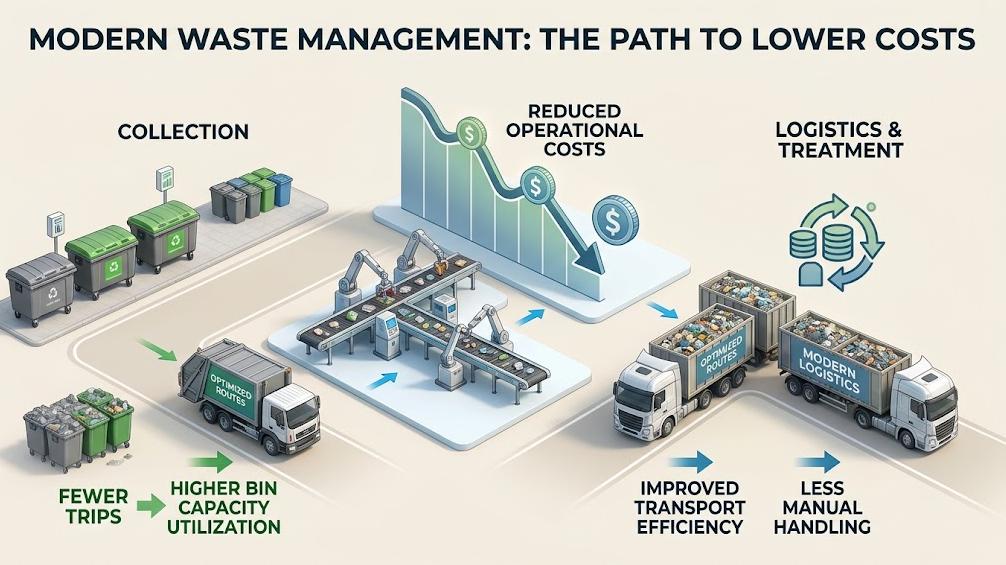
The key to reducing the cost of waste collection lies in optimizing the entire waste disposal process, rather than merely focusing on the purchase cost of individual equipment.
This mainly includes:
- Reducing unnecessary collection and transportation frequencies
- Increasing the capacity utilization of waste bins and vehicles
- Appropriately using waste compression technology
- Arranging collection according to actual needs
- Reducing manual handling and equipment downtime
- Coordinating collection, sorting, compression and transportation processes
Therefore, a well-designed waste management system can transform these measures into long-term operational cost savings.
5 Ways to Reduce Waste Collection Costs
1. Reduce Unnecessary Collection Trips
Each waste collection incurs costs for labor, fuel, vehicle operation, and maintenance. Collecting waste when the bins are not full leads to waste of resources.
Properly configuring the capacity of waste bins and collection times can reduce unnecessary collection frequencies. For scenarios with large amounts of waste, choosing appropriate-sized waste bins and efficient collection equipment can increase the utilization of existing capacity.
The goal is clear: collect waste based on actual needs, rather than frequently collecting according to a fixed schedule.
Read more: Choose the Right Waste Collection Equipment
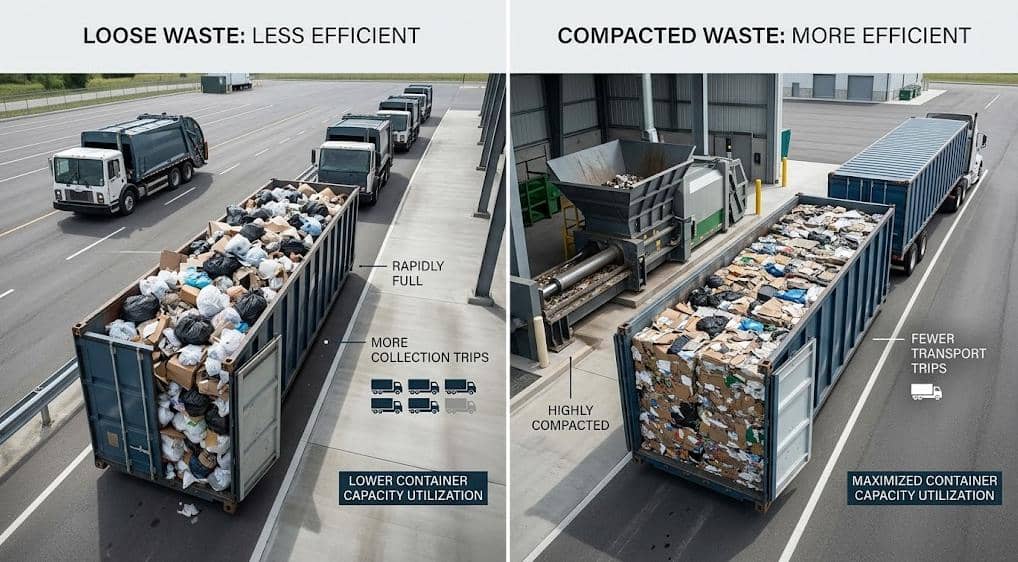
2. Use Waste Compaction to Improve Transportation Efficiency
Uncompressed waste occupies a large space and can easily cause the waste bins and collection vehicles to reach their capacity limits prematurely.
waste compactor can increase the density of waste before transportation, thereby more fully utilizing the capacity of waste bins and vehicles, and reducing transportation times, fuel, and labor costs.
For facilities with large amounts of waste production, integrating mobile or fixed compressors into the collection system can further improve transportation efficiency.
3. Collect Waste Based on Actual Demand
Traditional waste collection usually follows a fixed schedule rather than adjusting according to the actual filling level of the trash cans. This may result in some trash cans being collected before they are fully filled, while other locations need to handle the situation earlier.
Smart waste collection technology can adjust the collection plan according to actual needs. Through fill level sensors and real-time monitoring, operators can identify the trash cans that need to be collected and adjust the collection priority. This on-demand collection method can reduce unnecessary collection frequencies while optimizing routes and resource allocation, especially suitable for large commercial and municipal facilities.
4. Reduce Manual Handling and Equipment Downtime
Labor costs and equipment downtime directly affect the efficiency of waste collection. Unnecessary handling, repetitive operations, and unreasonable equipment layout increase the labor demand and reduce operational efficiency. Equipment downtime can also disrupt the collection plan and increase maintenance costs.
The key to improving efficiency is to have various equipment work together rather than evaluating each piece of equipment separately. The proper coordination of trash bins, compressors, containers, and transportation equipment can reduce unnecessary processing steps, allowing waste to be collected and transported more smoothly. Reliable equipment and timely maintenance also help reduce downtime and maintain the stable operation of the collection process.
5. Optimize the Entire Waste Flow
The key to reducing costs lies not in individual equipment, but in optimizing the entire waste disposal process: collection → sorting → compaction → transportation → treatment.
Each step can affect the overall operational efficiency. For instance, low-cost collection containers that are difficult to empty, incompatible with the compactor, or not suitable for the transportation system may lead to higher long-term operating costs. An efficient waste management system should ensure that equipment, capacity, and workflow are mutually compatible.
A systematic management approach also helps in evaluating the total cost of ownership (TCO). Besides the initial purchase price, long-term costs such as collection frequency, labor, fuel, maintenance, downtime, and equipment lifespan should also be considered.
How HD Helps Reduce Waste Collection Costs
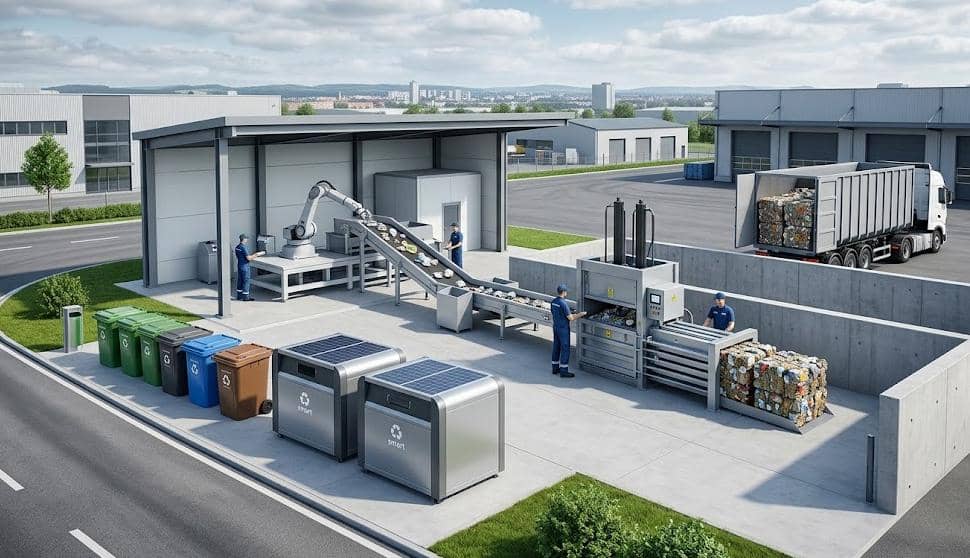
HD employs a systematic waste management approach to help clients enhance the overall efficiency from collection to transportation. We comprehensively consider factors such as waste volume, site conditions, workflow, and transportation requirements, rather than focusing solely on individual equipment. We provide matching solutions for different application scenarios.
Our solutions cover the main aspects of waste management:
- Collection: waste bins, recycling bins, and intelligent recycling bins
- Compression: Mobile and fixed waste compressors
- Transportation: Waste transportation containers and compressed containers
- Customization: Customized equipment based on site and operational needs
By coordinating collection, compression, and transportation equipment, HD can reduce unnecessary handling, increase equipment and capacity utilization, and simplify project management. Customized solutions and one-stop support enable clients not only to focus on initial procurement costs but also to make choices based on long-term operational efficiency and total cost of ownership (TCO).
Final
Reducing the cost of waste collection is not just about choosing cheaper equipment; it is more about optimizing the operation of the entire system. Reducing unnecessary transportation, improving the efficiency of waste compression, collecting on demand, reducing manual handling, and coordinating equipment all contribute to lowering long-term operating costs.
For enterprises that aim to control long-term costs, instead of asking “Which equipment is cheaper?”, they should ask “How can we make the entire waste collection process more efficient?”
HD can assess collection plans based on waste volume, site conditions, and operational requirements, and provide customized equipment and solutions from collection to transportation, helping customers improve overall operational efficiency.