
The Role of Custom Clothes Drop Boxes in Community Textile Recycling Programs
Circular economy system. Nowadays, textile recycling is no longer a marginal environmental publicity stunt, but a necessity for sustainable urban development. However, when implementing recycling programs in communities, the operational side often encounters numerous challenges.
Traditional general recycling bins are difficult to achieve the expected results. Due to the lack of clear identification, they are easily overlooked by residents, vandalized, and even mistaken for garbage bins, resulting in serious cross-contamination. The success of community recycling not only depends on logistics but also on public trust and cooperation. Therefore, investing in customized clothes drop boxes that are both visually attractive and strategically planned is the core to improving the efficiency of community recycling.
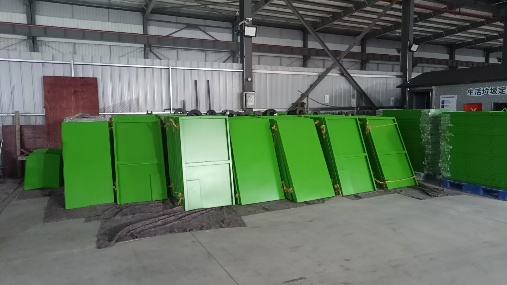
Why “Customization” is the Secret to Higher Recycling Participation
To change public behavior, you must first capture public attention. Customization transforms a cold, functional piece of street furniture into an interactive community landmark that inspires civic responsibility.
Visual Branding & Identity
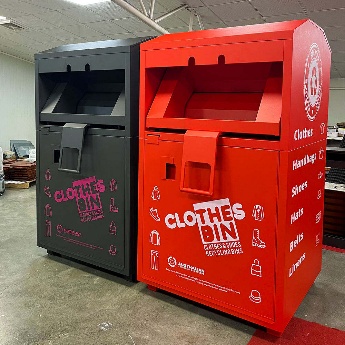
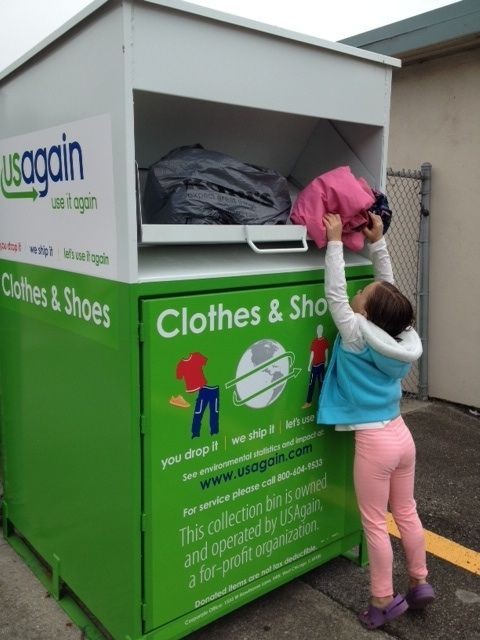
In public spaces, trust is the foundation. When faced with an unmarked and rusty traditional steel box, residents find it difficult to feel at ease in putting their clothes inside. However, with customized designs, municipal and charitable organizations can directly incorporate their brand logos, official color schemes, and trust badges into the box design.
Whether it is the vibrant green color of the municipal environmental protection project or the highly recognizable brand color of international non-profit organizations, a standardized visual image can quickly establish credibility. When donation boxes exude professionalism and authority, the trust of the community will naturally arise. This not only leads to a higher amount of donations but also effectively reduces malicious damage.
Intuitive Diagrams and Classification Labels
In the process of textile recycling, manual sorting is the most costly bottleneck. Wet garbage, household waste or non-recyclable materials mixed in by residents often lead to the scrapping of entire batches of textiles. For this problem, customized design provides a solution at the source.
By using the weather-resistant and fade-resistant screen printing technology, the front of the box can be printed with clear and eye-catching illustrations. Through intuitive classification markings – such as checking for recyclables (clean clothes, shoes, bed sheets) and crossing for non-recyclables (organic waste, plastic), immediate guidance is achieved. This visual guidance can effectively prevent misclassification and ensure the purity of recycled textiles from the source.
Tailored Dimensions for Diverse Locations
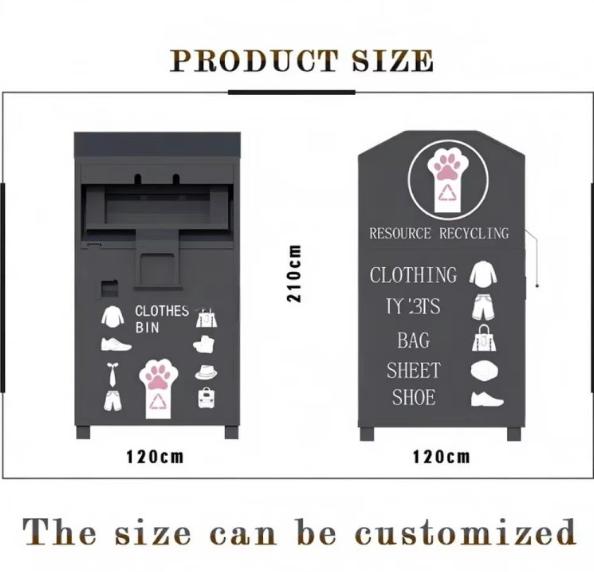
In the complex urban environment, equipment of a single specification is often insufficient to cope. Large old clothing recycling bins placed in industrial areas or transportation hubs, if directly moved to the narrow sidewalks of a campus, would easily obstruct traffic; while placed outside upscale shopping districts, they would appear out of place.
Customized dimensions ensure that the product specifications are perfectly matched with the space and foot traffic at the placement site. By flexibly adjusting the width, height and depth of the steel structure framework, manufacturers can not only create compact equipment suitable for indoor spaces, but also provide ultra-large reinforced devices suitable for high-capacity collection points.
Key Design Features for Successful Community Deployment
A good appearance and clear identification are indeed important, but a solid structure is the core for long-term operation in the outdoors. Placed in an unattended open-air environment, the recycling bins must be sturdy enough to withstand harsh weather and malicious damage.
- Sturdy material: The equipment should be made of thick galvanized steel plates ranging from 1.2mm to 2.0mm. This high-strength material is resistant to heavy impacts, wind, and durability. Even after years of exposure to weather, it can still ensure the stability, non-displacement, and non-deformation of the box.
- Outstanding wind and rain resistance: Prolonged exposure to wind and sun can easily cause equipment to rust and fade, affecting the city’s appearance. This product adopts outdoor-grade electrostatic powder spraying and high-temperature baking processes, which can form a powerful protective layer that is resistant to corrosion and fading. At the same time, combined with the internal rain-proof board and drainage channel design, it can strictly prevent rainwater from seeping in, ensuring that the fabric inside the box is dry and free from mold.
- Anti-theft and Public Safety: Public donation boxes often face the risks of theft or deliberate damage. To protect the items and avoid public liability, the box is equipped with an anti-theft feeding port – featuring a counterweight barrier design, making it easy to put in clothes but difficult to retrieve, effectively preventing arms or tools from entering. Additionally, reinforced steel plates combined with hidden double-door locks provide strong anti-picking and anti-damage protection.
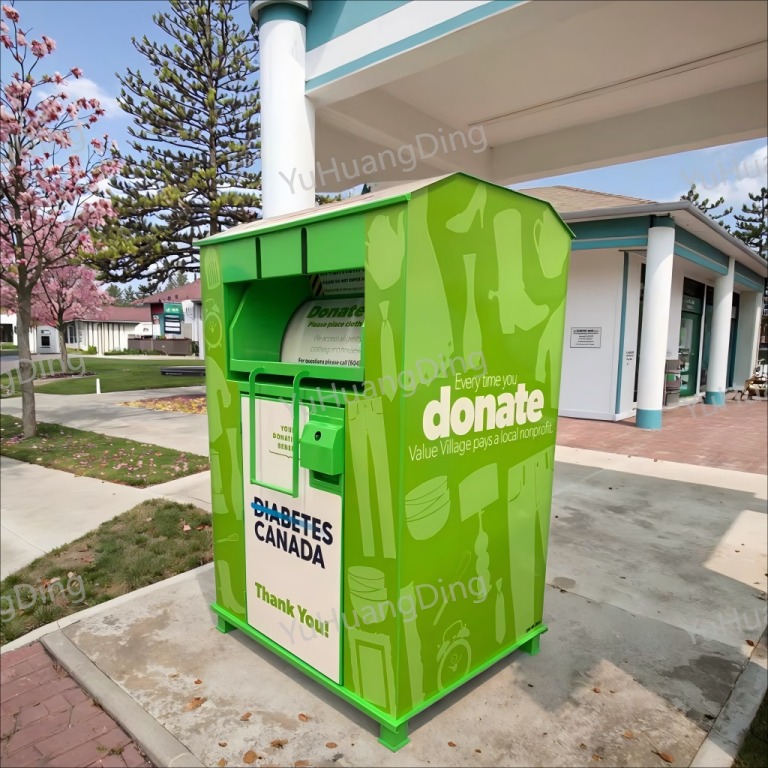
Best High-Traffic Locations to Deploy Your Clothes Drop Boxes
To increase the return on investment of clothing recycling, the location of the recycling bins is of crucial importance. To continuously obtain a large quantity of high-quality and clean used clothes, custom-made recycling bins should be precisely placed in areas with high foot traffic and convenient for vehicle parking:
- Educational institutions: Universities and school districts are prime locations for clothing recycling. During the peak period when students move out of their dormitories at the end of the semester, placing brand recycling bins in the dormitory areas or the main parking lot can efficiently collect a large amount of unused clothing.
- Business districts and shopping centers: Set up prominent recycling bins at the exits of shopping malls or parking lots of supermarkets, so that citizens can easily donate their clothes during their regular shopping or weekend purchases.
- Municipal parks and transportation hubs: Place high-visibility, durable recycling bins at subway entrances, transfer parking lots, or around the parks. This not only ensures a high frequency of exposure but also helps establish a distinct green public welfare image.
HD Custom Clothes Drop Box Solutions
Implementing large-scale community textile recycling will inevitably present operational challenges, but the hardware equipment should not be the bottleneck. HD Outdoor Facilities is committed to transforming your environmental protection strategy into high-performance, durable, and practical facilities.
Directly purchase custom clothing recycling bins from our factory, and you will enjoy the following four core customization benefits:
- Visual Branding: Supports customized printing of logos, slogans, and vivid full-color patterns on the entire box body, maximizing public trust and guiding standardized distribution.
- Color and Coating: Supports customizations with brand-specific colors or full RAL color charts. Utilizes highly durable powder coating that is impervious to outdoor weather conditions.
- Dimensions and Structure: Based on the spatial limitations and capacity requirements of the placement area, the physical dimensions, feeding chute, and internal structure of the recycling box can be flexibly customized.
- Functional accessories: Upgradeable heavy-duty anti-theft lock, integrated rainproof cover, and dedicated inner lining bag, making the collection of clothes safer and more convenient.
Help your sustainable development projects. Welcome to contact the HD Outdoor Facilities team to obtain factory-direct quotations and customized design plans, so as to maximize the community recycling rate of heavy-duty clothing donation boxes.