How to Restore and Refinish Weathered Outdoor Metal Furniture?
Whether it’s a row of park benches along a commercial waterfront, metal trash receptacles outside a hotel entrance, or seating clusters on a university campus, these pieces are exposed to rain, UV, salt air, and daily use — often year-round. At some point, the finish fades, rust appears, and the question becomes: replace or restore?
For most facilities and commercial operators, restoration is the smarter financial decision. And done correctly, it extends the service life of your furniture by several years without requiring a full procurement cycle.
This guide covers the complete restoration process for commercial outdoor metal furniture — from initial assessment through final protective coating — along with specific tips for the metal types most commonly used in commercial settings.
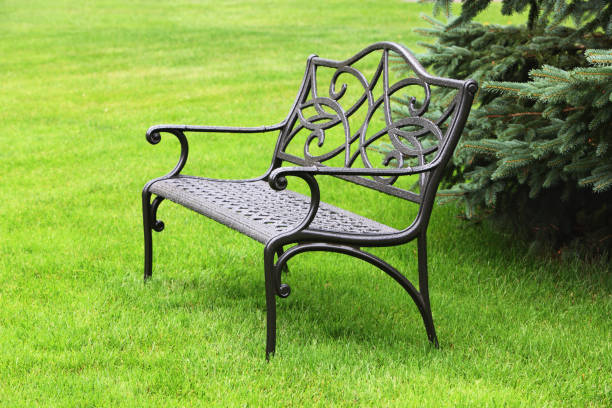
Why Restore Metal Outdoor Furniture Instead of Replace?
Replacing outdoor furniture at scale is expensive. A single commercial-grade metal bench can cost $400 to $1,200. Multiply that across a full outdoor seating area, a campus courtyard, or a resort pool deck, and a replacement decision becomes a significant capital expenditure.
Restoration changes that math considerably. Material costs for a professional refinishing job — surface prep, primer, paint, and protective coating — typically run a fraction of replacement cost per unit. Even factoring in labor time, restoration is almost always the lower-cost path when the structural integrity of the furniture is still sound.
There’s also a lead time consideration. Ordering new commercial outdoor furniture often involves 8 to 14 week lead times, particularly for custom finishes or specific configurations. Restoring existing inventory can be done on-site or through a local finishing contractor, usually within days.
Beyond cost and timing, maintaining consistent aesthetics across a facility matters. Replacing some units while leaving others in place creates a mismatched look that’s harder to manage than a coordinated refinishing program.
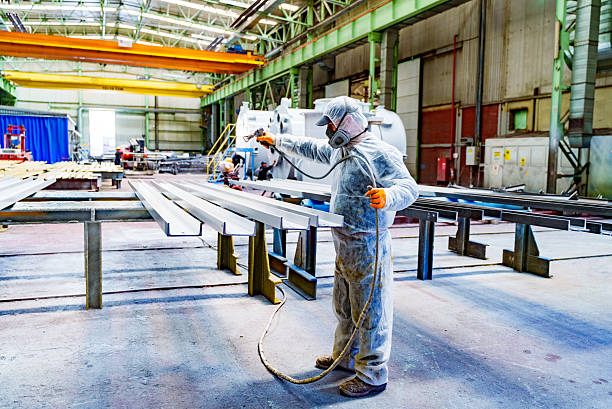
Tools and Materials Needed to Restore Outdoor Metal Furniture
The right materials make a significant difference in how long a refinished surface holds up under commercial use. Here’s what a proper restoration requires:
Surface preparation:
- Wire brushes and drill-mounted wire wheels for mechanical rust removal
- Sandpaper in multiple grits: 80-grit for heavy corrosion, 150-grit for general prep, 220-grit for final smoothing
- Chemical rust converter for deeply corroded areas
- Commercial-grade degreaser
- Tack cloths and drop sheets
Primers and finishes:
- Rust-inhibiting metal primer (spray or brush-on, depending on the surface geometry)
- Outdoor-rated metal paint in the required finish and color
- Clear protective topcoat or powder coat sealant where applicable
Safety and site management:
- Nitrile gloves and eye protection
- N95 respirators for sanding and spray application
- Ventilation setup if working in enclosed or semi-enclosed areas
For larger commercial projects — refinishing 20 or more pieces, for example — it’s worth evaluating whether powder coating through an outside finishing shop is more cost-effective than brush or spray application on-site.
Step-by-Step: How to Restore Outdoor Metal Furniture
Step 1 — Assess the Inventory and Prioritize
Sort pieces into three categories: those with surface rust and faded finish only (good candidates for full refinishing), those with moderate structural wear but intact welds and joints (restorable with more prep work), and those with compromised structural integrity — cracked welds, significant material loss from corrosion, or bent frames that affect function. That last category should be flagged for replacement rather than refinishing; restoring structurally unsafe furniture creates liability.
Step 2 — Clean All Surfaces Thoroughly
Effective restoration starts with a clean surface. Pressure washing is efficient for commercial quantities — it removes dirt, biological growth, bird deposits, and loose paint quickly. Follow with a degreaser to remove any oil or grease residue, particularly on furniture near food service areas or loading zones.
Let pieces dry completely before moving to the next step. Paint and primer applied to damp metal will not adhere properly, which shortens the life of the entire finish.
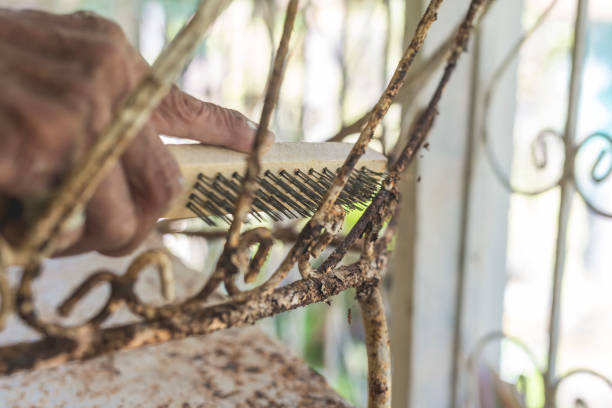
Step 3 — Remove Rust and Strip Old Paint
Use a wire brush or drill-mounted wheel for mechanical removal of surface rust and loose paint. For deeply pitted corrosion, apply a chemical rust converter and follow the manufacturer’s dwell time before wiping or rinsing. The converter transforms iron oxide into a stable compound that can be primed directly.
On heavily layered paint surfaces — common on furniture that has been refinished multiple times before — a chemical stripper may be necessary to get back to clean metal. This adds time but is preferable to priming over a poorly bonded paint stack.
Step 4 — Sand to a Consistent Profile
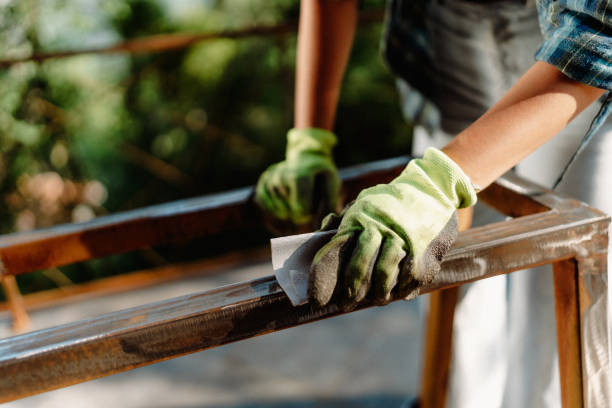
After rust and paint removal, sand the entire surface to create a uniform profile that primer can bond to. Work through grits progressively: start at 80 or 150 depending on how rough the surface is, and finish with 220-grit for a smooth, even substrate.
Pay specific attention to welds, joints, and decorative elements — areas with geometry that a flat sanding block can’t easily reach. Folded sandpaper or small sanding sponges work better in those spots.
Remove all dust with a tack cloth before priming. Any residue left on the surface will show through the final finish.
Step 5 — Apply Rust-Inhibiting Primer
Primer is the foundation of a durable outdoor finish. For commercial metal furniture, use a rust-inhibiting primer rated for exterior use. Two thin coats are more effective than a single heavy application — thick primer coats are prone to running, uneven drying, and reduced adhesion.
Allow the first coat to dry fully before applying the second, and lightly sand between coats with 220-grit to knock down any dust nibs or surface imperfections. Wipe clean before the second coat.
For aluminum furniture, a common material in commercial outdoor seating and accessories, you should confirm that your primer is compatible with non-ferrous metals. Standard iron-focused rust inhibitors do not bond reliably to aluminum and should not be used on it.
Step 6 — Refinish with Exterior-Grade Paint
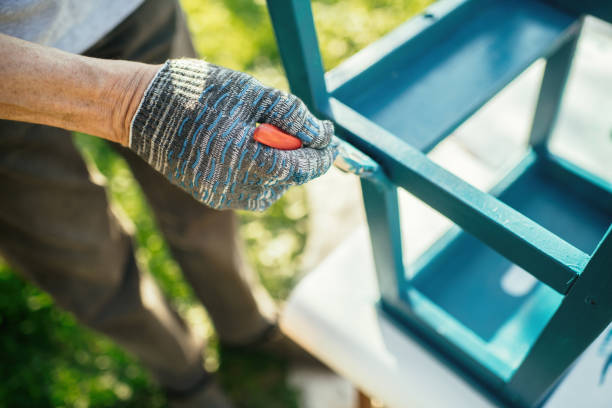
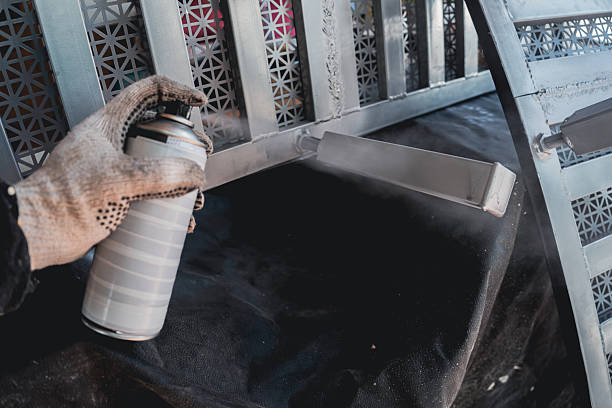
With primer in place, the piece is ready for its finish coat. For commercial applications, exterior-grade spray paint formulated for metal provides the most consistent coverage across complex surface geometries. Products with a built-in UV inhibitor are worth the additional cost — UV degradation is one of the primary causes of early finish failure on outdoor furniture.
Apply two to three thin coats, allowing each coat to dry to the touch before adding the next. Rushing this step leads to runs, uneven sheen, and poor adhesion between layers.
Color matching matters in commercial settings. If you’re refinishing a subset of a larger furniture installation, confirm the paint color against existing pieces before committing to a full batch. Most commercial paint suppliers can match existing colors by sample.
Step 7 — Restore Shine and Apply a Protective Topcoat
Once the paint has fully dried (typically 24 hours at room temperature), apply a clear protective topcoat. For painted surfaces, a UV-resistant clear enamel adds a meaningful additional layer of protection against moisture and sun exposure. For unpainted or polished aluminum, a metal polish followed by paste wax restores surface luster and slows re-oxidation.
This topcoat is what separates a finish that lasts two seasons from one that holds up for five or six. According to guidance from the American Coatings Association, UV-resistant clear coatings over exterior metal paint systems can extend finish life by 30 to 50 percent compared to paint alone.
Apply in thin, even passes and allow full cure time — typically 48 hours — before returning furniture to active use.
Step 8 — Cure, Inspect, and Return to Service
Allow restored pieces to cure fully before use. Paint that feels dry to the touch is still hardening chemically, and putting furniture back into service too early can leave surface marks or cause the finish to crack under load.
During the curing period, do a final inspection across all restored pieces. Look for thin spots, uneven sheen, or any areas where corrosion was not fully addressed during prep. Touch those areas up before the furniture goes back out. A consistent final inspection step prevents pieces from returning to rotation that will need attention again within months.
Refinishing Considerations by Metal Type
Commercial outdoor furniture is produced in several metal types, each of which behaves differently during restoration.
Wrought iron is structurally durable and common in decorative commercial furniture — benches, tables, planters. Its textured surface retains moisture in joints and ornamental details, which accelerates rust. Mechanical removal of rust followed by rust converter is usually necessary. Two coats of rust-inhibiting primer are advisable before painting.
Aluminum does not rust, but it does oxidize. The chalky white surface oxidation common on older aluminum furniture requires a different approach: oxidation removal with an aluminum-specific cleaner, followed by priming with a non-ferrous primer. Aluminum is also the most common material in commercial outdoor trash receptacles and litter bins, where surface oxidation is a common maintenance issue.
Powder-coated steel — the most common material in contemporary commercial outdoor furniture, it is generally durable, but chips and scratches in the powder coat allow moisture to reach bare metal underneath. Spot repairs on powder-coated steel require careful surface feathering before touch-up to avoid visible edges at the repair site. For large areas of powder coat failure, re-powder coating through a finishing shop usually produces better results than liquid paint touch-ups.
Preventing Future Weathering: Some Maintenance Tips
For commercial operators managing outdoor furniture at scale, a structured annual maintenance program is more cost-effective than reactive restoration. A basic program involves an end-of-season inspection to identify pieces needing attention, touch-up of any chips or scratches before the winter period, and protective covering or indoor storage for pieces in regions with harsh winters.
During active use periods, a routine cleaning schedule — removing biological growth, salt, and surface contaminants every four to six weeks — significantly slows finish degradation. This is particularly relevant for coastal installations, where salt air accelerates corrosion on any exposed metal surface.
For facilities managing large furniture inventories, tracking restoration dates and finish types by unit helps prioritize annual maintenance budgets and avoid surprises. A piece restored five years ago with a standard liquid paint system should be on a scheduled inspection list; one powder coated three years ago likely has more runway.
With over 20 years of experience in outdoor furniture manufacturing, HD is reliable. If you have any questions about maintenance, materials, or long-term performance, feel free to reach out.
FAQs
Can heavily rusted commercial outdoor furniture be restored?
In most cases, yes — provided the structural integrity of the piece is intact. Surface and mid-level rust can be removed through a combination of mechanical sanding and chemical rust converter. The determining factor is whether corrosion has compromised the structural metal, particularly at joints and welds. If a weld has separated or a structural member has significant material loss, the piece should be assessed by a fabricator before refinishing.
What’s the best paint system for refinishing outdoor metal furniture at a commercial level?
For commercial applications, a two-component epoxy primer followed by a polyurethane topcoat provides the highest durability in liquid-applied systems. For smaller operations or spot refinishing, rust-inhibiting alkyd enamel or direct-to-metal (DTM) paints are more practical and still deliver good outdoor performance.
How long does a refinished metal furniture finish last under commercial conditions?
With thorough surface preparation and a protective topcoat, a well-executed refinish should last four to seven years under normal commercial use. High-traffic or coastal locations will see shorter intervals. A basic annual maintenance routine including cleaning and spot touch-ups can extend that range significantly.
Is it worth refinishing commercial aluminum trash receptacles and bins?
Yes, particularly for receptacles that are structurally sound but visually degraded. Aluminum bins oxidize rather than rust, and the restoration process is simpler than for iron or steel: oxidation removal, non-ferrous primer, paint, and topcoat. The process typically costs a fraction of replacement and restores the consistent appearance that matters in hospitality or municipal settings.
At what point does replacement make more sense than restoration?
Replacement becomes the better decision when structural damage is present, when the cost of restoration approaches or exceeds 50 percent of replacement cost, or when the existing furniture no longer meets current safety or accessibility standards. For everything else, restoration is generally the more economical choice.
Related Products