
How Does Waste Bin Layout Design Affect Waste Sorting?
Having more waste bins does not necessarily mean better waste sorting. In many public spaces, offices, residential communities and commercial facilities, there may be enough bins available, yet recyclable materials still end up in general waste and food waste contaminates recycling streams.
The problem is often not a lack of awareness. It is the layout.
Where a waste bin is placed, how close the different waste streams are to each other, and whether users can recognise the correct opening quickly can all influence what people actually do. Research from the University of British Columbia, for example, found that moving recycling and compost bins closer to users produced substantial increases in participation.
For waste management equipment manufacturers, this is something that becomes clear through real projects as well as research. A well-designed bin still needs to be placed where people naturally need it.
This guide looks at the main principles behind effective waste bin placement and how they can be applied in residential areas, offices, parks and other public spaces.
Why Waste Bin Layout Matters More Than Simply Adding More Bins
When someone is carrying a bottle, food container or piece of packaging, the disposal decision often takes only a few seconds. Most people are unlikely to make a long detour simply to find the correct bin.
This is why convenience matters.
A study by researchers at the University of British Columbia compared different bin locations in apartment buildings and student residences. When compost bins were moved from the ground floor to individual floors, composting increased by 70%. In another part of the study, placing recycling and composting stations about 1.5 metres from residence doors increased recycling and composting by an average of 141%.
The lesson is straightforward: if the correct disposal option is difficult to reach, participation can fall even when people understand the importance of recycling.
However, distance is not the only factor.
Research by Nattapon Leeabai and colleagues at Tokyo Institute of Technology examined how the distance from walking paths, separation of bins and bin arrangements affected waste collection and sorting. Their results showed that longer distances away from a walking path reduced combustible waste collection, while some tested changes in arrangement did not produce significant differences in sorting efficiency.
This is an important distinction. There is no single layout that works equally well everywhere. The position of the bin needs to match how people actually move through and use a space.
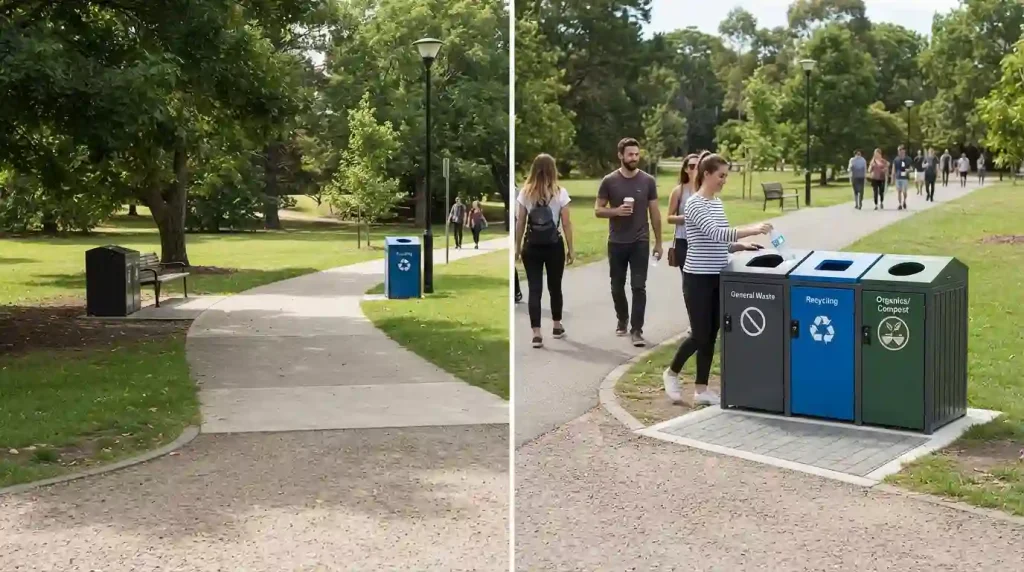
The Main Principles of Effective Waste Bin Placement
1. Keep General Waste and Recycling Bins Together
One of the most practical rules is simple: do not place recycling bins on their own when users are expected to dispose of different types of waste.
If a person has both a recyclable item and general waste, they should be able to choose between the two without walking to another location.
Industry guidance from Busch Systems recommends placing recycling and trash bins directly next to each other. CleanRiver also recommends pairing landfill and recycling bins so users can make the choice at the same point of disposal.
For locations where food waste is commonly produced, such as cafeterias or food courts, an organics bin can be added to the same station.
The exact combination should always follow the local waste collection system. A three-stream station is useful only when those three streams are actually collected and processed separately.
2. Put Bins on Natural Walking Routes
A bin that is technically nearby but outside the normal walking route may be less useful than one positioned directly along the path.
Entrances, exits, elevators, seating areas, dining spaces and busy intersections are often good starting points. In offices, for example, waste stations can be positioned near kitchens, break rooms and printer areas rather than hidden in a corner.
This principle is also supported by recent research. A 2026 systematic review by Anna Högberg and Patrik Sörqvist examined 44 studies selected from 440 screened articles and found that location, proximity and accessibility all affect waste-bin behaviour. Importantly, the review concluded that being located on a common walking path may matter more than distance alone.
Before deciding where to put a bin, therefore, it is worth watching the site for a few minutes. Where do people actually walk? Where do they stop? Where do they consume food or drinks? These observations can tell you more than a floor plan alone.
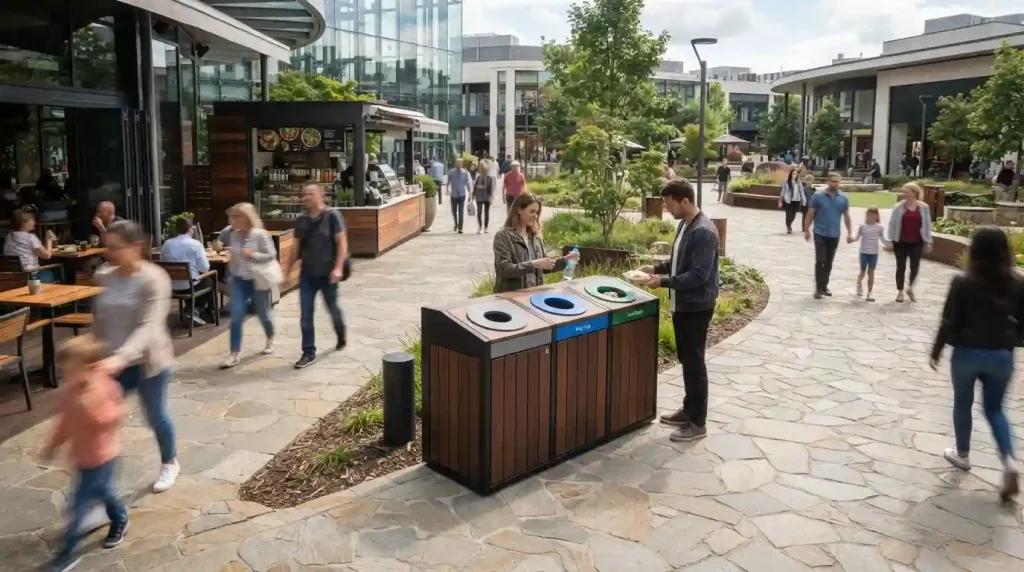
3. Reduce Unnecessary Distance
People do not necessarily need a bin directly beside them at every moment, but unnecessary walking creates friction.
This is particularly important in residential buildings, offices and large public facilities. If residents have to take waste several floors away, or employees need to cross an entire office to find a recycling station, the general waste bin may become the easier choice.
The UBC research provides a useful example of how relatively small changes in distance can affect behaviour.
For larger facilities, this does not mean placing a bin every few metres. Instead, look for points where several user routes naturally meet and make those locations convenient enough that people do not need to make a special trip.
4. Make the Whole Station Easy to Understand
Good placement can still fail if users cannot tell which opening is for which material.
Colour, icons, labels and opening shapes should work together. The latest systematic review of waste-bin design found evidence that visual salience can attract attention, while clear prompts, symbols, lid shapes and slot openings can help guide disposal behaviour. It also found that simple, explicit symbols and only necessary wording are generally preferable to information-heavy signs.
Research from Tokyo Institute of Technology has also examined people’s preferences for recycling-bin colours and opening designs. The study found that colour preferences varied according to the waste type and design element, and that existing familiarity with certain colours was associated with preference.
For manufacturers and facility managers, the practical point is not to choose colours simply because they look attractive. The colour and signage should be consistent with the local recycling system and remain consistent across the entire site.
5. Standardise the Arrangement
If every waste station uses a different order, users have to stop and read the labels each time.
A standard arrangement can make repeated use easier. For example, a facility might consistently position general waste on the left, recycling in the centre and organics on the right, provided this arrangement fits the local collection system.
There is an important qualification here. Research does not show that one particular left-to-right arrangement is universally superior. Leeabai’s research found that tested arrangements did not significantly change waste collection or separation performance.
The practical benefit of standardisation is therefore more about predictability than about finding one “perfect” order. Once a layout is established, keeping it consistent across the site makes the system easier to recognise.
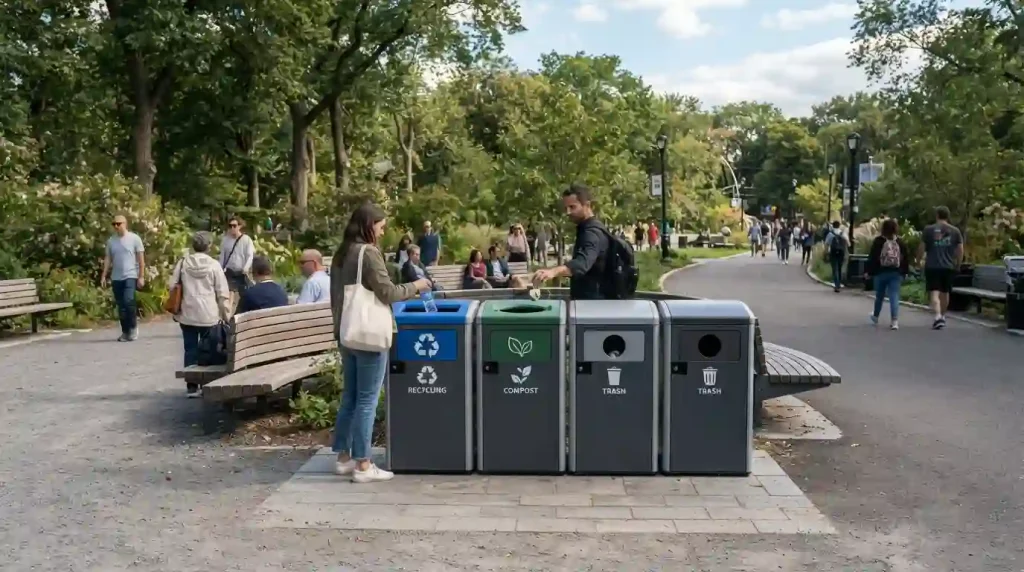
How Layout Changes in Different Settings
Residential Communities
Residential areas require a balance between convenience, collection efficiency and available space.
A central waste room may work for some developments, but it can create unnecessary walking for residents. Where the building design allows it, smaller collection points closer to residential floors can make correct disposal more convenient.
Some Chinese residential waste-management projects have also adopted combined facilities that provide separate areas for everyday household waste and recyclable materials. The idea is useful because different waste streams can remain organised while still being located within the same general collection area.
The right solution depends on building size, collection frequency, local regulations and available space. The important point is to design around residents’ actual routes rather than simply choosing an unused corner for the bins.
Offices and Commercial Buildings
Commercial spaces should follow the points where waste is generated.
Paper waste is common around printers. Food waste is concentrated around kitchens, cafés and staff dining areas. Packaging waste is common near delivery and unpacking areas.
This means a single recycling station at the end of a corridor may not be enough.
Busch Systems’ recycling guidance similarly recommends locating collection points around areas such as break rooms, cafeterias, printer stations and entrances or exits.
At major entrances and exits, a complete station containing the main waste streams can also provide a convenient final disposal point before people leave.
Parks, Streets and Public Spaces
Outdoor placement needs to account for both pedestrian movement and where consumption takes place.
In parks, seating areas, picnic spaces, food stalls and busy paths are usually more useful locations than isolated corners. Bins should also be easy to see without obstructing pedestrian movement.
For outdoor equipment, weather resistance, capacity and servicing access matter as much as placement. A bin that is positioned correctly but regularly overflows can quickly become a source of litter.
This is where layout and product selection need to be considered together. Outdoor waste bins with appropriate capacity, durable materials and suitable openings can support the layout rather than work against it.
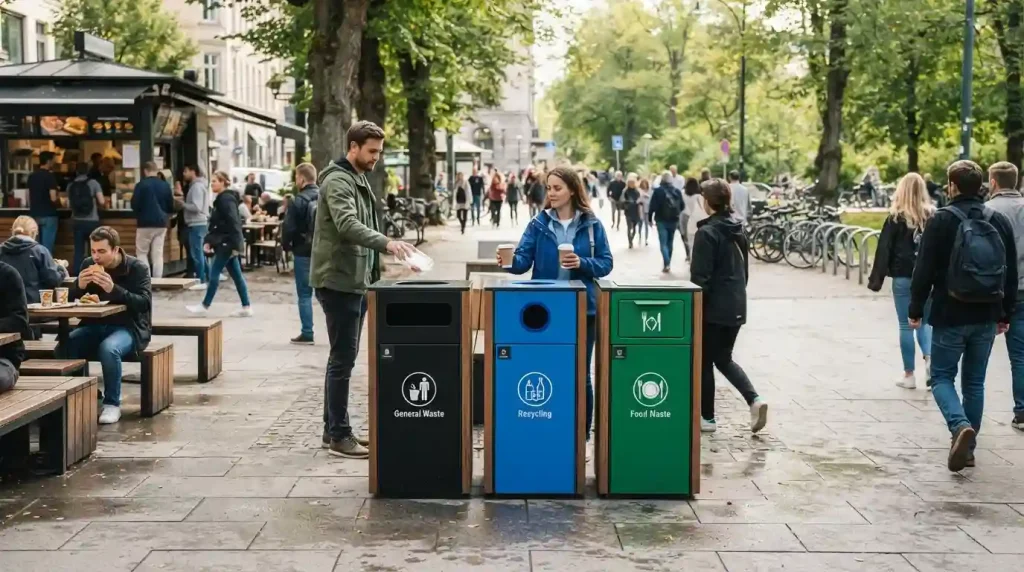
Common Waste Bin Layout Mistakes
Adding more bins is often the first response when a site has a waste problem. But quantity alone does not solve poor placement.
A few common mistakes are worth checking.
First, recycling bins are placed separately from general waste bins. Users then have to choose between walking to another station or using the nearest available opening.
Second, bins are positioned according to available space rather than user movement. A convenient-looking corner for facility management may be inconvenient for everyone else.
Third, every station uses a different configuration. Even if each station is individually well designed, inconsistent layouts make repeated use less predictable.
Fourth, signage is treated as an afterthought. Small labels, excessive text or unclear openings can make the correct choice harder than it needs to be.
Finally, the facility never checks the results after installation. A layout should be tested in actual use rather than treated as a finished decision.
How to Test and Improve Your Layout
A practical layout review does not require complicated equipment.
Start by observing three things: where people walk, where waste is generated and when the busiest disposal periods occur. Then check the current contamination rate or, where possible, weigh different waste streams.
Next, change only one or two collection points. Keep the new arrangement for two to four weeks and compare the results with the previous setup.
For example, if a recycling station currently sits around a corner, move it directly onto the main route and keep the bin design and signage unchanged. If recycling participation improves, the location may have been part of the problem.
This approach is more useful than making several changes at once because it gives facility managers a clearer idea of what actually worked.
The same principle can be applied when selecting waste bins. Capacity, material, opening design, colour, signage and modular configuration should be considered together with the planned location.
Conclusion
Effective waste sorting does not start with the bin alone. It starts with the system around the bin.
Research shows that convenience, accessibility, visibility and location can influence disposal behaviour, while practical industry guidance consistently recommends pairing major waste streams and placing collection stations where people naturally need them.
At the same time, research also shows that not every layout change produces the same result in every setting. That is why good waste bin placement should be based on both evidence and actual site conditions.
The most reliable approach is straightforward: place the right waste streams together, keep them on natural walking routes, make the disposal choices easy to understand, use a consistent layout and measure the results after installation.
For manufacturers and facility managers, this also means looking beyond the appearance of an individual bin. A well-designed waste collection station should fit the space, the waste generated there and the way people actually use the area.
A better layout may require fewer changes than expected. Sometimes, moving the existing bins to the right place is the first improvement worth making.
- Sources and further reading:
University of British Columbia — Making Bins More Convenient Boosts Recycling and Composting Rates - PubMed — The Effects of Setting Conditions of Trash Bins on Waste Collection Performance and Waste Separation Behaviors
- PubMed — Perceptive Preference Toward Recycling Bin Designs
- Wiley — The Effect of Waste Bin Design on Observable Recycling Behaviour: A Systematic Review and Research Agenda